Fewer parts.
What each additional component costs in manufacturing and assembly, and when a part has to remain separate.
Every component has a dimensional tolerance and at least one connection to another part. Any connection can come loose, shift or wear. A product with fewer parts therefore has fewer places where it can fail.
What a part costs
An additional part needs its own tool or its own step in manufacturing. It has to be stored, inspected and assembled. Every assembly step is a possible source of error.
A part becomes visible as a joint. Where two parts meet, there is an edge where dust collects and moisture can get in. A continuous surface has no such edge.
When a part stays separate
The Design for Assembly method developed by Boothroyd and Dewhurst checks every part on the bill of materials against three questions. A part stays separate if at least one answer is yes:
- Does it move relative to the parts around it?
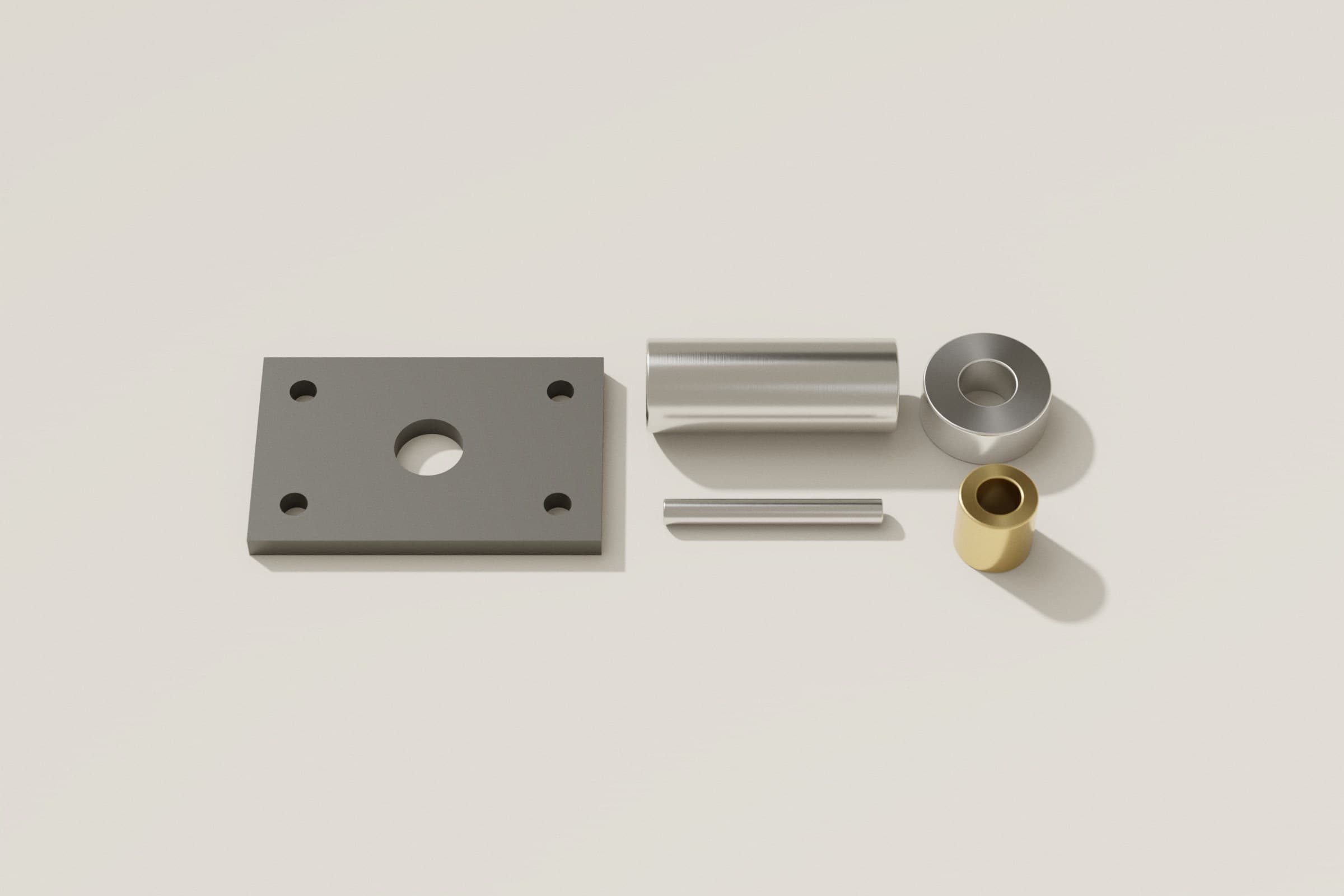
- Does it have to be made of a different material, for example as a seal, bearing or insulator?
- Does it have to remain separate so that other parts can be assembled or removed?
If every answer is no, the part can be combined with a neighbouring part.
Wear parts
The third question also covers parts that wear. If a wear part is combined with a load-bearing part into one component, the whole component has to be replaced once it is worn. A shorter bill of materials is only an advantage if individual parts can still be replaced.